V. Medinsky’s Personality as a Reflection of Putin’s Goals for Negotiations With Ukraine
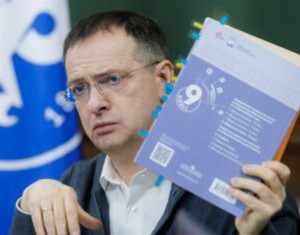
By slowing down the negotiations with Ukraine, Russia is not actually giving them up, as it does want to achieve its goal. Therefore, among other things, it is worth paying attention to the person who heads the Russian delegation, V. Medinsky. A respected person in this matter, he is completely satisfied with Putin’s goals for the negotiation process. By the way, the Kremlin leader deliberately appointed V. Medinsky to lead the Russian delegation, taking into account both his biography and his considerable experience in propaganda and political activities. And also because of his strong chauvinistic views, without which none of the Russians will be able to win the president’s trust. At the same time, V. Medinsky may look like an influential person only at first glance. In reality, he is a pawn on Putin’s political chessboard and is even involved in corruption and criminal cases.
The fact that Russia is dragging out peace talks and trying to use official meetings with Ukraine to realize its political and propaganda interests is noticeable even without a geopolitical magnifying glass. It is sufficient to pay attention to how Russia demonstrates its strategic goal of destroying Ukraine as an independent state. The content of Russia’s demands to Ukraine, as well as the statements, speeches, and actions of the Russian delegation at the talks, can be interpreted in this way. Moscow’s well-known “desires” regarding Ukraine are essentially ultimatums. They do not even need to be commented on. But as for the statements or speeches of the Russians themselves… Their analysis determines exactly what Russia is now seeking to achieve.
Thus, the Kremlin is trying to intimidate Ukraine and, against this background, force it to agree to Russia’s terms for ending the war. The members of the Russian delegation promise that Ukraine will lose much more of its territories if it does not agree to give away those that Moscow is claiming now. It goes so far that Russian negotiators cynically warn that relatives and friends of our delegation members may die at the front. And when such threats did not work, Russian representatives began to claim that a missile strike against Ukraine using the so-called “Oreshnik” was possible. Hinting that ordinary Russians are already demanding this, but the Kremlin is not fully prepared for such an act yet.
Another intention of the Kremlin’s henchmen is to humiliate Ukraine, thus demonstrating their “supremacy”. That’s why the Russian delegation included minor figures who have no right to make any of the important decisions. True, no one in Russia has such rights anyway, except for Putin himself. Nevertheless, their behavior is defiant. In general, Russians always behave this way until they get a decent response. As was the case, for example, with the SBU’s Operation “Pavutyna” (“Spiderweb” – Transl.), during which a large number of Russian strategic aircrafts were destroyed… The Kremlin is also trying to impose a narrative about “Ukraine’s historical entry into the Russian world.” Therefore, they say, Ukraine cannot be independent and sovereign. And if anything, it is only allowed to remain a part of Russia. That is why the war against Ukraine is nothing more than the RF’s internal affairs, and the West has no reason to intervene. Especially since Russians and Ukrainians are supposedly fraternal peoples who were artificially divided and now, again artificially, have been pitted against each other by Ukrainian Nazis, with the support of Europe and the United States. As for Moscow itself, within the framework of such approaches, it is trying to persuade Ukrainians that their further resistance to Russia is futile and thus to make them capitulate. At the same time, the Kremlin hopes that it will also be able to dissuade the West from further supporting Ukraine. Not least, with the assistance of D. Trump, who finds Russia’s position on Ukraine reasonable.
So we can see that Moscow is not giving up on further negotiations with Ukraine, or on the above-mentioned goals. The third technical meeting of the two delegations is currently being prepared, during which the parties’ proposals for a truce are to be discussed. It is not yet known when this will happen, but one way or another, the delegations will meet. Again, we will see Russian representatives, and again they will be appointed not at random, but in accordance with Moscow’s interests, and again they will probably be headed by V. Medinsky. How could it be otherwise? He, like no one else, fully and completely meets all the Kremlin’s criteria! It is sufficient to look through the pages of his biography and review his actions at all stages of his life.
In particular, V. Medinsky was born in 1970 in the city of Smila, Cherkasy region of Ukraine, into a military family. In the early 1980s, his family was transferred to Moscow. That is, formally, he can be considered a native of Ukraine who came to Russia at a young age and later recognized it as his second homeland. In view of this, V. Medinsky personifies the “unity of Russia and Ukraine”, which fits perfectly with Moscow’s ideological attitudes. Besides, according to such probable calculations, the fact of V. Medinsky’s Ukrainian origin should be positively perceived by Ukraine and the Ukrainian delegation, which will affect the fulfillment of certain tasks.
The head of the Russian delegation to the talks with Ukraine has a humanitarian education: in 1992, he graduated from the Moscow State Institute of International Relations with a degree in international journalism. At the same time, he interned as an assistant press secretary at the USSR (and later Russian) embassy. In other words, the Kremlin believes that Ukraine and the world should perceive him as a supporter of peaceful, not military, solutions to the problems in relations between Russia and Ukraine. At the same time, he also has a democratic consciousness and Western views that were formed or could have been formed during the “thaw” in the USSR and Russia and during his stay in the United States, when he studied and worked there at a young age.
After graduation, V. Medinsky and his coursemates opened an advertising and PR agency called “Ya” Corporation”, which he headed. In 1996, the agency was on the verge of collapse due to the bankruptcy of large pyramid-clients. However, he managed to stay afloat, as he successfully combined his business and academic activities at MGIMO. Postgraduate studies followed, and in 1994 he began teaching at the same Institute. In 1999, V. Medinsky defended his dissertation and became a doctor of political science. How it really happened – more on that later, but now about the next pages of his biography.
In 1998, V. Medinskyi’s life and work took a sharp turn. He joined the civil service and became an adviser to the director of the Federal Tax Police Service of Russia, S. Almazov on image issues. Later, he became the head of the Information Policy Department of the Ministry of Taxes and Duties. However, his activities did not last long. Already in 1999, he headed the work with regional media at the election headquarters of the “Fatherland – All Russia” bloc in the elections to the State Duma of the third convocation. He got there under the patronage of the head of the aforementioned ministry, G. Boos, who also entered politics.
In the early 2000s, V. Medinsky was a member of the central council of the all-Russian political organization “Otechestvo” (“Fatherland”- Transl.). And after G. Boos was appointed Deputy Chairman of the State Duma, he became his advisor until 2002. In December 2001, V. Medinsky joined the “Unity and Fatherland – United Russia” party, the future ruling party of the country. There he was a member of the party’s central council, in 2002-2004 he headed its Moscow executive committee, and in 2003 he headed the election headquarters in Moscow. In 2004-2005, he was the deputy head of the CEC of “United Russia” and was elected to the State Duma on the party’s federal list. He was a member of the State Duma of the fourth and fifth convocations in 2004-2011 and a member of the Bureau of the party’s Supreme Council.
At that time, Medinsky also became involved in propaganda and “cultural” work. In 2010, he was included in the “Commission to Counter Attempts to Falsify History to the Detriment of Russia’s Interests”. During its two years of existence, the Commission actively fought against the “myth” of the Holodomor and justified Stalin’s policies. In 2011, he joined the board of the “Russky Mir”(“Russian World” – Transl.) Foundation, which promoted Putin’s cultural and propaganda policies abroad. In the same year, he headed the Duma Committee on Culture.
Thanks to all this, he gained extensive experience in propaganda and party activities and… the use of intrigue, which is an important feature of character for a negotiator, not to mention the head of a negotiating team. In addition, his being a Doctor of Political Science and his status of a former MP of the State Duma of the Russian Federation and one of the highest-ranking officials of the current ruling party, “United Russia”, add to his weight. As a well-educated and authoritative figure, he is well versed in political affairs.
In 2012, Medinsky reached a new level in his activity, which had a positive impact on his career. He became a confidant of the then-Prime Minister and presidential candidate of the Russian Federation, Vladimir Putin. As a result, he became part of Putin’s inner circle. After Putin was elected President of the Russian Federation, he was awarded the position of Minister of Culture. In this position, Medinsky turned the Ministry of Culture into an openly aggressive instrument of state propaganda for the ideas of the “Russian World”, using cultural and historical policy to strengthen the dictatorship of the regime at that time. He also left his own “cultural legacy” in the form of a string of openly chauvinistic books with a tendency to distort facts. Although, according to many Russian analysts, those books were written by a team of authors funded by the Ministry of Culture. Such assumptions are confirmed by his dissertation, which is characterized by plagiarism. In 2017, the Expert Council of the Higher Attestation Commission of the Russian Academy of Sciences reviewed the dissertation and recommended that the author be stripped of his doctorate in history. However, the then head of the Russian Ministry of Education, O. Vasilyeva, refused to comply with this recommendation.
Medinsky’s work as Minister of Culture of the Russian Federation fully satisfied the President, and was marked by a number of awards. However, in 2020, V. Putin was forced to change the country’s government, which was a consequence of a sharp decline in the authority of the government due to the negative consequences of the COVID-19 epidemic. V. Medinsky resigned along with the entire government. But the President did not intend to abandon the former minister and appointed him as his advisor. This appointment once again confirms that V. Putin trusts V. Medinsky, which is why the latter remained in the President’s inner circle. So, Putin appointed him head of the delegation, and in fact, his representative in negotiations with Ukraine. At the same time, he is not considered a key figure in the Russian leadership, and therefore falls under the so-called category of low-level representation in the negotiation process.
All these characteristics describe Medinsky as a typical representative of Putin’s regime. However, there is something else to add. Or rather, a question to ask: would he have become what he is if he had not been closely integrated into Putin’s corrupt and criminal system? Medinsky is said to have been involved with crime at a young age, when he was running an advertising agency. Most of his clients were, in one way or another, involved in organized crime or were its direct offspring. Apart from companies such as the MMM financial pyramid, they included representatives of the gambling and tobacco businesses. He later lobbied for their interests in the Russian State Duma. And as Minister of Culture of the Russian Federation, he had to deal with criminal and corrupt activities. Thus, the Prosecutor General’s Office of the Russian Federation repeatedly issued warnings to V. Medinsky in connection with violations detected in the Ministry of Culture. In particular, in 2013, during a Prosecutor’s inspection, it was established that the responsible persons of the Ministry did not take measures to defend the interests of the state in the field of cinematography. In other words, they were embezzling budget funds. Of course, that could not have happened without the Minister’s knowledge, but it had no consequences for him.
In 2016, prosecutors exposed the fact that the Ministry of Culture had created conditions for the illegal export of cultural property abroad. Ministry officials, including high-ranking ones, turned a blind eye to the abuses of experts who underestimated the value of works of art by hundreds of times. As established by the Prosecutor’s office, V. Medinsky covered for them and received a share of the illegal proceeds. And again, as the Russians say, “it’s like water off a duck’s back”.
In the same year, the FSB opened a criminal case against some employees of the Russian Ministry of Culture and contractors for embezzlement of state funds intended for the restoration of federal cultural heritage sites. As a result, State Secretary of the Ministry of Culture G. Pirumov and Head of the Investment Department B. Mazo were arrested. Medinsky himself claimed to know nothing about his deputy’s criminal activities. Of course, few believed this, but even the FSB was unable to bring him to justice.
And this is only what lies on the surface and has been officially reported. A more thorough search in the media reveals many other examples of Medinsky’s similar actions, including bribes and “kickbacks” for assistance in organizing various mass events, and the “hogging” of cultural institutions in the interests of business and criminal structures. Moreover, there is also something about his involvement in drug trafficking. And no punishment for all this, no responsibility whatsoever. Not even condemnation for his actions, at least not publicly. And how could it be otherwise if he has a high-ranking patron who does not abandon his men unless they are no longer useful. At the same time, as in the cases of other Russian officials, such illegal activities by V. Medinsky give Putin powerful leverage over his subordinate. Therefore, no matter how much V. Medinsky wants to, he cannot go against the President or violate his instructions. However, this is common practice in Russia for everyone.
Therefore, Medinsky fully meets Putin’s criteria for the head of the Russian delegation in negotiations with Ukraine. Here are the main ones: he is subservient to Putin; he embodies Putin’s ideas about the “unity” of Ukrainians and Russians; he has experience in propaganda and political activities; he gives the impression of being an educated and influential person with democratic and Western thinking (although, in reality, this is not the case at all).
Thus Medinsky’s behavior at the negotiations and all his speeches and statements reflect Putin’s goals and position, which provide for dragging on the negotiations and pretending before the USA that the peace talks are taking place in order to avoid sanctions. At this, moral and psychological pressure is being exerted on Ukraine to demand its capitulation.
At the same time, Medinsky’s illegal activities, which may still be ongoing, discredit not only him but also those he represents. This weakens Russia’s negotiating position, which Ukraine and its Western partners can take advantage of.
Oleh Halan,
Institute of Global Politics